
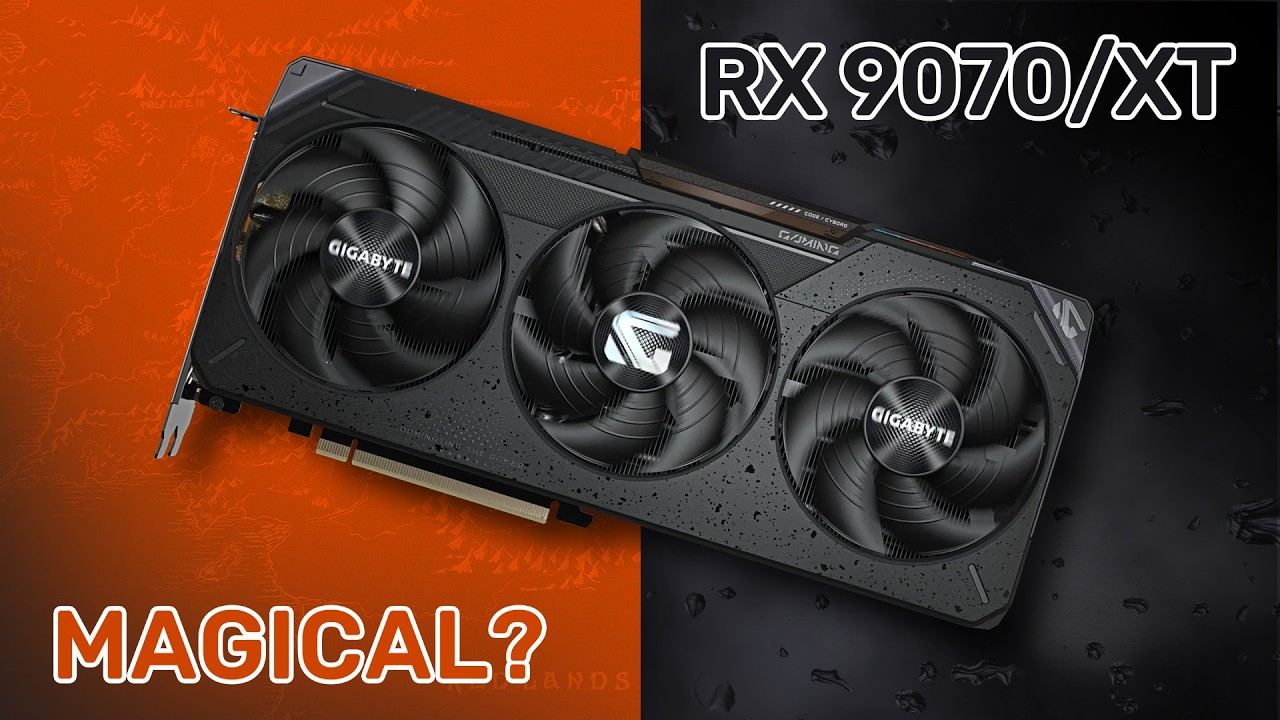

RX 9070 & 9070 XT Review: Raw Power, No Bull
Graphics cards—those elusive beasts of the PC hardware desert. They're most likely to be seen in sordid back-street deals rather than on your local electronics high street. Fear not, though, because they really do exist—and in 2025, Gigabyte has released two contenders that deliver serious credentials without the hokum: the RX 9070 and RX 9070 XT.
These cards have been touted as some of the best value-for-money GPUs released this year, and after spending time with both, I’m inclined to agree. Let's dive into what makes them tick—and whether they're worth a spot in your rig.
Under the Hood: Specs Breakdown
On the surface (and even inside), the RX 9070 and 9070 XT are quite similar:
Memory: 16GB of GDDR6
Render Output Units (ROPs): 128
Memory Bus: 256-bit
The main differentiator is the GPU itself. The 9070 XT features:
Increased Clock Speeds:
Base Clock: 2400 MHz (about 330 MHz above the 9070)
Boost Clock (OC variants): Up to 3060 MHz (versus 2700 MHz on the standard 9070)
Increased Stream Processors:
XT: 4096
9070: 3584
For context, stream processors are AMD's version of NVIDIA's CUDA cores. They handle parallel computations required for gaming and rendering—more of them generally means better raw performance.
Power & Efficiency
One of the best things about these cards? They are not power drunks.
The RX 9070 XT tops out at about 304W, so most users should be able to run it from a 750W PSU. And a bonus: Gigabyte hasn't employed any of that propitiatory cable malarkey—good old plain 2–3 simple 8-pin connections.
Design Philosophy: Minimalism Done Right
Gigabyte's approach in this instance is clear: all content, none of the frippery.
There is no over-the-top RGB, no flashiness—only dependable hardware in a neat, unadorned package. Some may find this too bland, but I think the emphasis on function is a plus.
The cooling system is handled by three of Gigabyte’s WindForce fans, which feature a refined fin design with mini-wings and strategic grooves. In testing, the 9070 XT maxed out at 70°C under full load in Furmark—and impressively, the fans never even hit 50% speed. That means even more thermal headroom if you’re okay with a little extra fan noise.
And while they're capable, they're not too big compared to today's standards—roughly 288mm long and 2.5–3 slots deep.
Real-World Performance
Both cards sit roughly between an RTX 5070 and a 5080 in raw rasterization performance. That's impressive for their price tag.
But when we talk ray tracing, things are different. The RX 9070 and 9070 XT are behind even NVIDIA's RTX 5060 Ti in ray-traced loads. So if ray tracing is very important to you, these might not be the cards you're looking for.
But if you're one of numerous gamers who don't mind so much about nice reflections and simply want pure FPS, then these cards are perfect. They'll handle 1440p with ease, and even light 4K gaming on less demanding titles. For best performance in AAA games, I'd stick at 1080p or 1440p—especially if you want to stay above 60 FPS.
The Verdict: Best Budget Performance of 2025
In a fairly modest GPU release year, the RX 9070 and 9070 XT are the best low-to-mid range GPUs of 2025—especially if you care more about performance per dollar than about ray tracing or AI-driven frame generation.
If you need raw gaming performance, and you don't care about not having the fluff, both of these cards are worth considering. Aggressive pricing, decent cooling, and solid build quality make them some of the best value available today.
Final Thoughts
Gigabyte has nailed the important points here: good performance, intelligent cooling, and no gratuitous fluff. If you're on the lookout for a GPU that delivers where it counts—and you don't need fancy lights or ray tracing marketing hoopla—the RX 9070 or 9070 XT is well worth the consideration.
Also: We just hit 100,000 subscribers! Thanks a million to each of you who've encouraged us—your views, likes, and comments are all that matter. Here's to the next milestone!
– Stefan @ WeDoTech
Spending money so you don't have to (and sometimes wasting it too)