
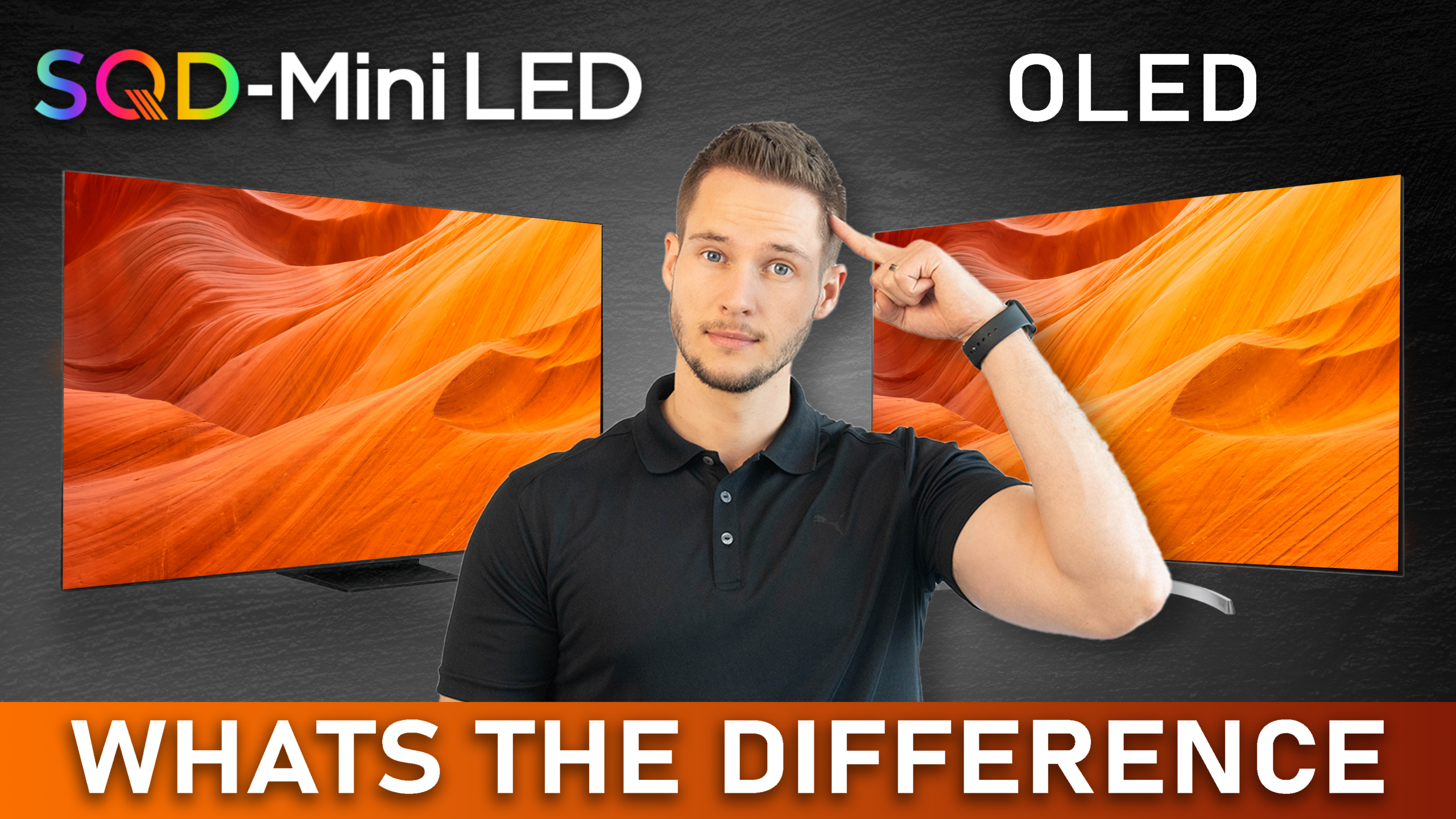

TCL C7L SQD Mini-LED: The OLED Killer We Didn't Expect
By Stefan @ WeDoTech
The TV That Almost Shouldn't Be This Good
There is a question that gets asked every time a new premium TV launches: is it worth it over OLED?
For most of the past decade, the honest answer was no. Mini-LED was always playing catch-up, always making excuses, always coming just close enough to make you consider it before you ended up buying the OLED anyway. TCL has decided that era is over. With their new Super Quantum Dot mini-LED technology, they are not trying to out-OLED OLED anymore. They are doing something smarter than that, and the 75-inch C7L is the most accessible way to experience it.
After spending time with TCL's new panel technology up close, one thing became very clear. This is not a minor upgrade. This is TCL combining the best parts of everything they have built into a single panel that gets closer to OLED than anything outside of, well, an actual OLED.
What TCL Actually Built
To understand why the C7L matters, you need to understand what Super Quantum Dot mini-LED actually is.
OLED has always had one defining advantage: perfect blacks. Each pixel is its own light source and can switch off completely, giving you essentially infinite contrast without affecting anything around it. The downside is that OLED pixels are made from organic material. They age. Modern OLEDs have largely eliminated the burn-in concern in practical use, but the organic limitation is real, and it is expensive to work around.
TCL's approach was not to beat OLED at its own game. It was to get close enough that most people would not notice a meaningful difference, while fixing the areas where OLED falls short.
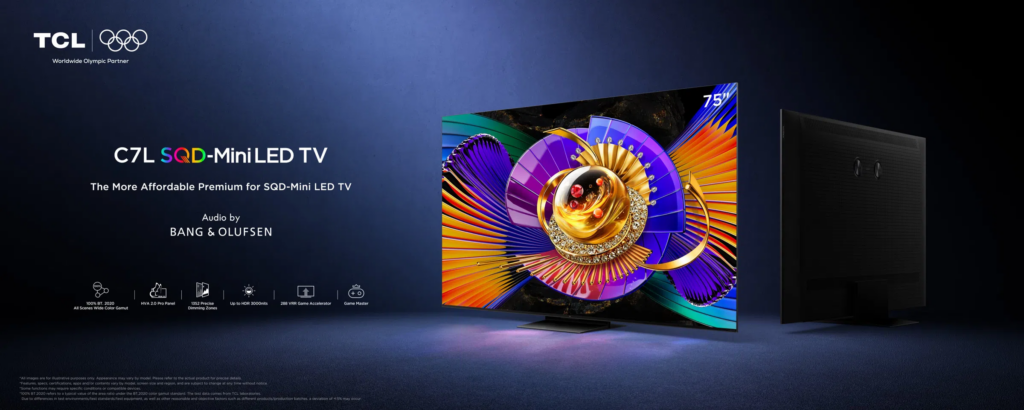
They did this by layering four technologies together. First, HVA 2.0, an upgraded VA panel that already produces some of the best native blacks and contrast of any LCD panel type. Because the panel itself starts with stronger blacks, the local dimming zones have less work to do. Second, their mini-LED backlight with precise local dimming, which on the flagship X11L reaches 20,000 zones and 10,000 nits of peak brightness. The C7L is the more accessible version of this, landing at 1,352 dimming zones on the 75-inch model and a peak brightness of 3,000 nits, which still puts it firmly in flagship OLED territory for HDR performance.
Third, the new Deep Color System. Traditional quantum dots have always had a consistency problem. The semiconductor particles vary slightly in size, and that variation causes colors to look washed out and inconsistent. TCL's Super Quantum Dot standard keeps each dot within one nanometer of each other, delivering far more precise color control and a significantly wider color range. TCL claims 100% BT.2020 color space coverage, though it is worth noting this refers to area ratio rather than every individual point within the color space. After talking to their engineers, it is a more nuanced claim than the headline suggests, but the practical result is genuinely impressive color performance. Fourth, improved halo control technology that reduces the light bleed typically associated with mini-LED panels.
The result of combining all four is a panel that handles the traditional weaknesses of mini-LED while keeping all the strengths.
Where It Pulls Ahead of OLED
TCL's C7L makes its strongest case in three areas where OLED genuinely struggles.
Brightness is the big one. At 3,000 nits peak, the C7L produces HDR highlights that most OLEDs simply cannot match. Colors hold their accuracy at high brightness levels in a way that matters enormously in a bright living room, which is where most TVs actually live. OLED panels look incredible in a darkened room. In daylight, the C7L has a real advantage.
Size is the second factor. A 75-inch OLED at this quality level costs considerably more. TCL's C7L in 75 inches comes in at around $1,400 currently at Best Buy. The flagship X11L at 75 inches sits at around $3,800. A comparable 75-inch OLED from Sony or LG would push well past $2,000 to $3,000 depending on the model. For buyers who want a large screen without a large bill, the C7L's value proposition is genuinely compelling.
The third advantage is longevity. Mini-LED panels do not degrade the same way organic panels do, which matters for anyone planning to keep their TV for several years.
The Honest Drawbacks
The C7L is not perfect, and it is worth being clear about that.
The 1,352 dimming zones on the 75-inch model is notably fewer than what you find on the flagship X11L or even the step-up QM8L. In scenes with very small bright elements against a dark background, some light bleed can still appear. TCL has reduced it significantly, but it has not been eliminated.
The C7L also does not support Dolby Vision 2, which is available on the pricier QM8L and X11L. For most viewers watching standard Dolby Vision content that distinction will not matter, but it is worth knowing if you plan to hold onto this TV for years as the format becomes more common.
Viewing angles, while improved by the HVA 2.0 Pro panel, still do not match OLED for households where people watch from wider positions around the room.
TCL C7L vs. LG OLED C5
At 75 inches, LG's C5 OLED sits at around $2,300 and represents the benchmark most buyers are comparing against. Here is where each makes its case.
The C7L wins on brightness, size per dollar, and longevity. The LG C5 wins on perfect pixel-level blacks, viewing angles, and infinite contrast. For a dark home theater setup where the lights go down for movie night, the C5's image quality in those conditions is still the better experience. For a bright living room, gaming setup, or anyone who wants the biggest screen their budget allows, the C7L makes a genuinely strong argument.
It is less about which TV is better in absolute terms and more about which strengths match your actual setup. Five years ago that was not a conversation worth having. Mini-LED simply was not close enough. Today it is.
Final Thoughts
TCL did something interesting with the C7L. They stopped trying to win a fight they were not going to win and started targeting the places where OLED genuinely falls short. The result is a TV that competes at a level that would have seemed impossible at this price point a few years ago.
At around $1,400 for the 75-inch model, it is one of the most persuasive arguments for rethinking the assumption that you need to spend OLED money to get an OLED-level experience. If you want to see what the technology looks like pushed to its absolute limit, TCL's own X11L is the benchmark, but the C7L delivers the same underlying technology at a price most people can actually justify.
It is not a perfect TV. But for the money and the size, it is a very difficult one to talk yourself out of.
If premium display technology interests you, check out our look at the Honor 600 Pro, another product proving that the gap between flagship performance and flagship pricing is closing faster than most people expected.