
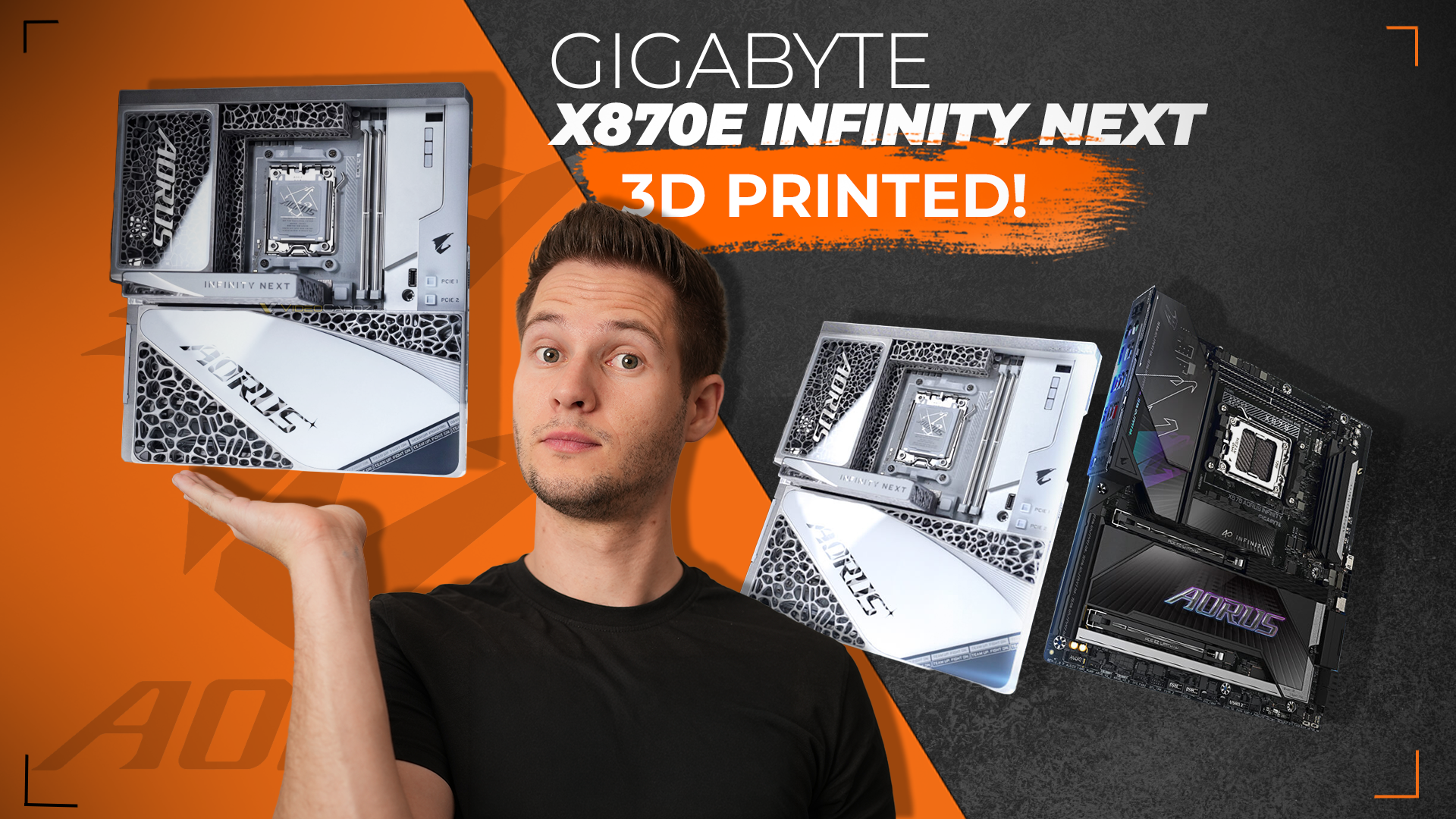

X870E AORUS INFINITY NEXT: The Rocket Science Motherboard
By Stefan @ WeDoTech
Gigabyte Built a Motherboard Using Rocket Thruster Technology. Yes, Really.
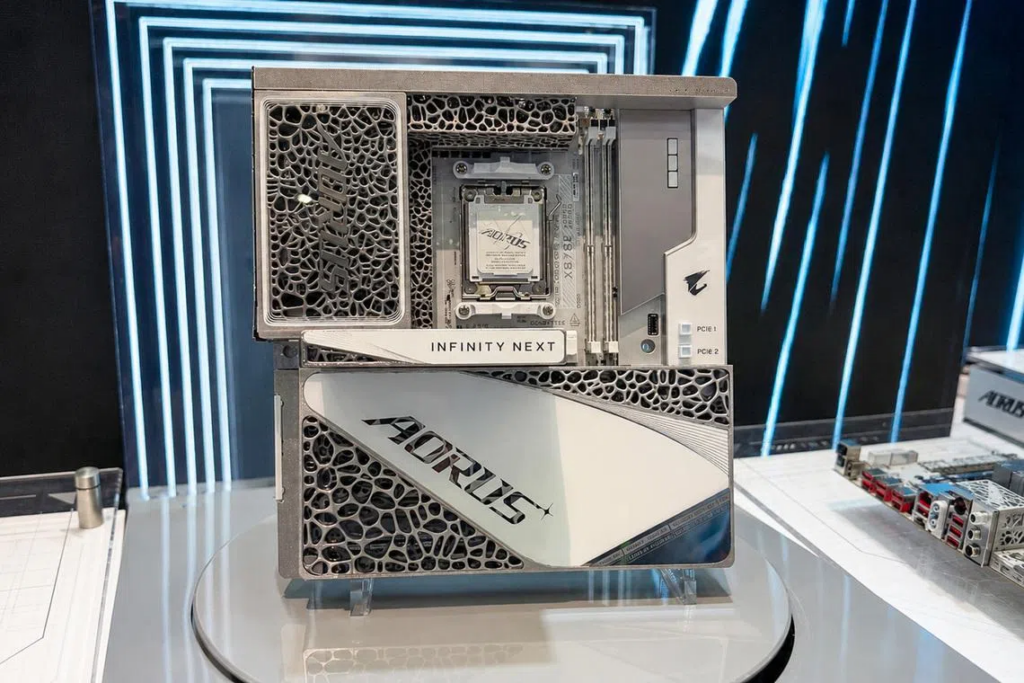
There is a long list of ways a company can celebrate 40 years in business. Gigabyte chose to build a motherboard using the same 3D metal printing techniques used to manufacture rocket thrusters and satellite components.
That sentence deserves a moment to land.
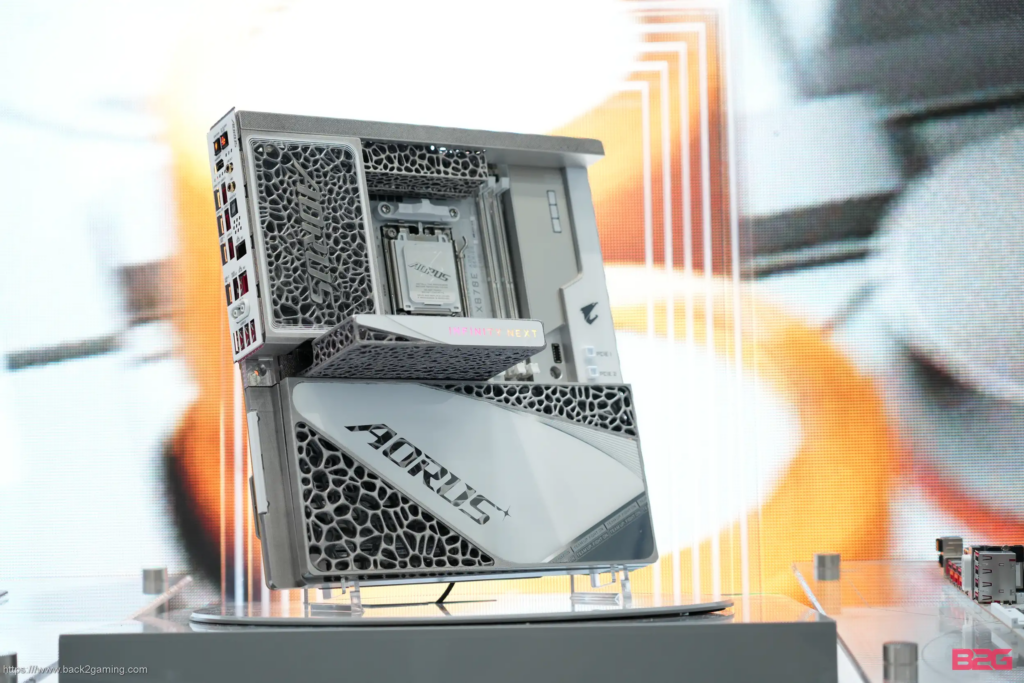
The X870E AORUS INFINITY NEXT is not a concept that exists purely to generate headlines, though it certainly does that. It is Gigabyte's answer to a question most people in the PC hardware industry stopped asking: what happens when traditional manufacturing methods stop being the limitation? After seeing it in person at Computex 2026, it is genuinely difficult to look at it and think about motherboards the same way again.
Why Rocket Science Belongs on a Motherboard
To understand what Gigabyte actually built, it helps to understand why they built it this way.
Conventional CNC machining, the process used to produce the heatsinks on essentially every motherboard sold today, can only create certain shapes. Fins, flat surfaces, simple geometries. Engineers have spent decades optimizing what is possible within those constraints, and the honest reality is that traditional cooling fin designs have essentially reached their limits. There is only so much surface area you can pack into a heatsink using conventional methods.
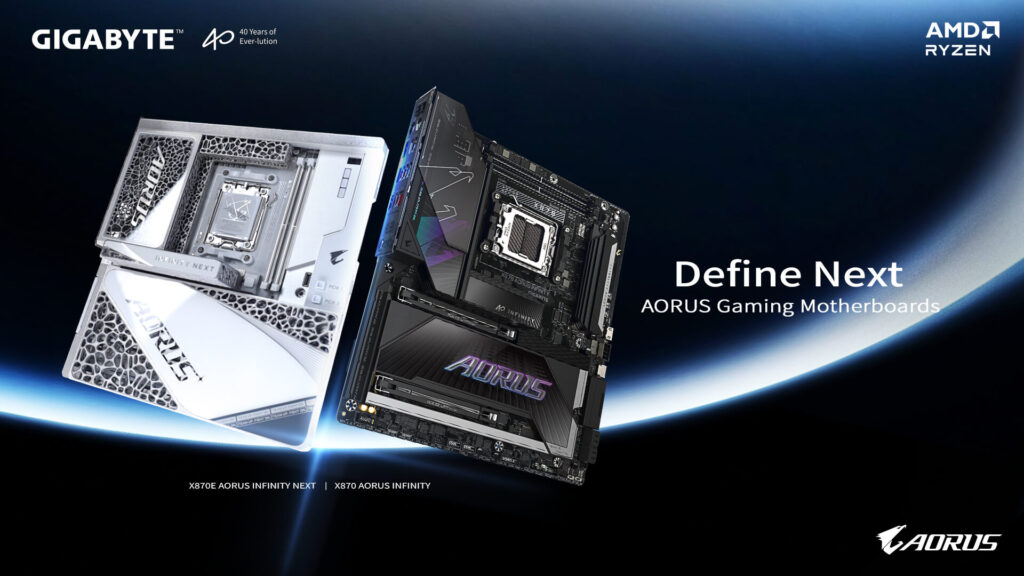
Metal 3D printing removes that constraint entirely. The same technology that allows aerospace engineers to create titanium brake components for hypercars and complex internal structures for rocket thrusters can produce shapes that CNC machines physically cannot. Gigabyte partnered with companies that manufacture aerospace components and adapted those techniques for the X870E AORUS INFINITY NEXT's cooling system.
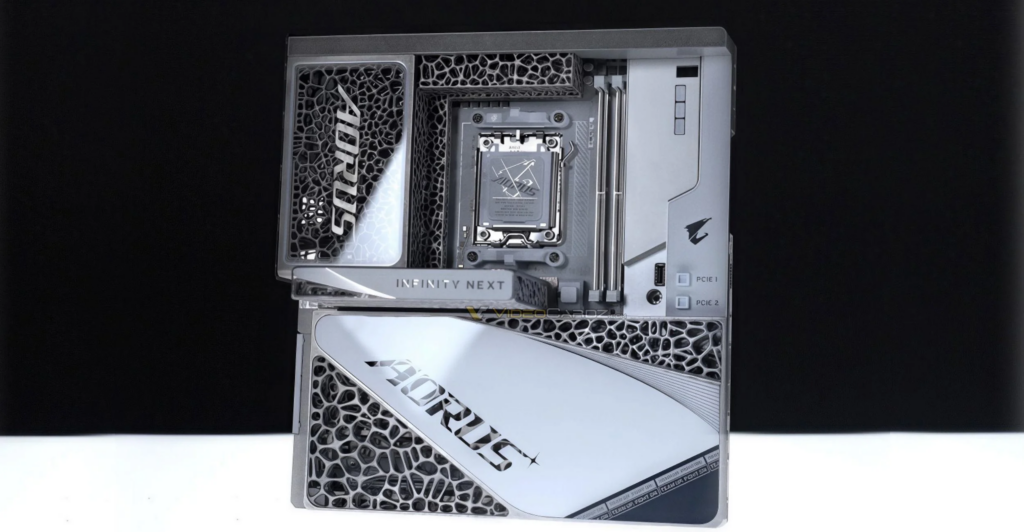
The result is what Gigabyte calls the AI Gyroid structure, a complex internal lattice built into the heatsink that massively increases cooling surface area while remaining lightweight. According to Gigabyte, this delivers 44% more cooling surface area compared to conventional heatsink designs. The 3D-printed vapor chamber and honeycomb-structured metal backplate extend the same approach across the board. In person, it looks less like a motherboard component and more like something that belongs inside a piece of aerospace equipment. Which is fitting, because the material science behind it comes directly from that world.
The Specs Underneath the Engineering
Beyond the manufacturing story, the X870E AORUS INFINITY NEXT is an extremely serious piece of hardware in its own right.
The board is built for AMD's Ryzen platform, supporting the latest Ryzen 9 9950X3D2 processors and memory speeds up to DDR5-11400 MT/s. The power delivery system features 64 phases using Quad OptiMOS technology rated for a theoretical 5,120 amps of total current capacity. Your processor will never come close to needing that. The point is that the power delivery system will never be the bottleneck under any workload, now or in the foreseeable future.
X3D Turbo Mode 2.0 is Gigabyte's AI-enhanced overclocking system, using an onboard hardware chip that monitors real-time system conditions and workload behavior to dynamically optimize performance for each specific processor. It is a meaningful addition for anyone running AMD's X3D processors and wanting to extract every last percentage point of performance without manual tuning.
The Honest Caveats
Pricing has not been confirmed. What Gigabyte did confirm is that the manufacturing cost for the 3D-printed cooling structures alone runs well into four figures, and each heatsink takes approximately two days to print. Whatever the retail price ends up being, it will reflect those realities. Expecting this board to land anywhere near conventional flagship motherboard pricing would be unrealistic.
Availability is also an open question. The nature of the manufacturing process means this is not a product that can be mass-produced at scale. Whether Gigabyte brings it to retail in limited quantities or keeps it as a demonstrator remains to be seen. Gigabyte's product team indicated they are actively exploring options and gathering feedback, but made no commitments.
It is also worth being clear that no processor currently on the market needs 5,120 amps of power delivery or the thermal headroom this board provides. The X870E AORUS INFINITY NEXT is not built for today's hardware requirements. It is built to demonstrate what becomes possible when you stop treating manufacturing constraints as fixed.
X870E AORUS INFINITY NEXT vs. Current Flagship Motherboards
Conventional flagship AM5 motherboards from ASUS, MSI, and Gigabyte's own standard lineup typically land between $500 and $800 for genuine enthusiast-tier boards. They offer excellent power delivery, strong overclocking support, and well-optimized VRM designs within the limits of traditional manufacturing.
The X870E AORUS INFINITY NEXT is not competing with those boards on value. It is competing with them on the question of what a motherboard can be when cost-per-unit and manufacturing simplicity are removed from the equation. For the overwhelming majority of builders, a conventional flagship board is the correct answer. The X870E AORUS INFINITY NEXT exists to show where the ceiling actually is, not where most people should be spending their money.
Final Thoughts
The most interesting thing about the X870E AORUS INFINITY NEXT is not the motherboard itself. It is the manufacturing technology behind it.
Gigabyte's willingness to partner with aerospace component manufacturers and apply those techniques to PC hardware raises a question that matters beyond this specific product: if 3D metal printing can deliver 44% more cooling surface area on a motherboard heatsink, what happens when that approach reaches graphics cards, power delivery systems, or cooling solutions in mainstream products? Gigabyte's product team confirmed they are open to exploring exactly that. Their words were "infinity and beyond," which is either a Buzz Lightyear reference or a genuine strategic direction. Possibly both.
The X870E AORUS INFINITY NEXT is excessive, overengineered, and going to cost a serious amount of money. It is also one of the most genuinely interesting pieces of hardware to come out of Computex 2026, for reasons that have nothing to do with benchmark numbers and everything to do with what it suggests about where PC hardware engineering is heading.
For more from Computex 2026, check out our coverage of MSI at Computex 2026, another booth that proved this year's show had no shortage of ideas worth paying attention to.